* Olav Cleofas van Overbeek *
...the serenest of lights, and the shade of a feeling ...
|
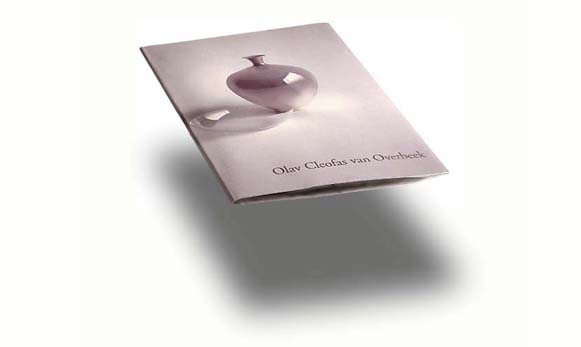
This catalogue has been published at the occasion of Olav Cleofas van
Overbeek's solo exhibition, 20 May - 1 July 2000, and is compiled and
written by Koen Nieuwendijk.
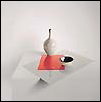
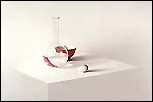
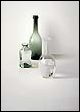
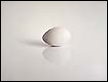
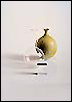
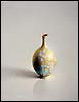
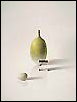
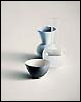
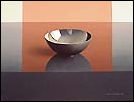
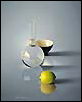
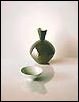
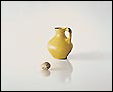
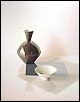
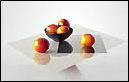
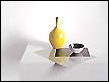
(16 pages, 23 full colour reproductions, ISBN 90-70-402-11-4) Confession If only you knew the background of the ponderings against which catalogue texts are wrought … Ideally the tone of voice should be one exuding a degree (though never an excess) of confidence. Catalogue texts are typically too short to enable you truly to "connect" with your audience. Any attempt at playing the gallery – pun fully intended – will blow up in your face. Had these restrictions not silenced me beforehand, I would tell you what Olav Cleofas van Overbeek's paintings do to me. Chances are that while reading, you would start thinking that given my official capacity, how could I be primarily concerned with anything but the sales side of things, so it was only natural for me to scramble for superlatives. In brief, if it weren't for me arguing with myself, I would tell you how on one occasion I could not hold back the tears when looking at a Van Overbeek painting. Yup: there I was, crying. It's true that I was wrapping up the painting to ship it to the United States at the time, an essentially historic moment – there I was, after 12 months of preparations, 12 months of travel and two days and nights of non-stop work without any sleep, triumphant yet moved by the final farewell, wrapping up my finest painting and sticking a stamp on it – but even so, I could by ignoring a taboo abuse the slight embarrassment that such a confession tends to generate, as if there is any need to take a detour to convince you of the superiority of Van Overbeek's still lifes … The ink of the above lines has only just had time to dry or nature plays a trick on my romantic feelings: as I sit staring out of the window of my office, wrapped in thought, the perfect rainbow appears above the canopy of trees in the courtyard, in colours which can barely touch on what Van Overbeek confers on his paintings … while I realise at the same time that these words with their implicit exaggeration are wasted on you, for breathtaking beauty will not be caught with cliché-ridden sentences. It's just as well I had already decided to grant you a peek behind the scenes. On Dreams In one of his interviews, Van Overbeek philosophises on inspiration, technique, and ideal. "Beauty is delicate," he says somewhere. The preceding sentence was to do with the thin layers of oil paint on his canvases, but much to my relief his comment had nothing to do with that, although it didn't say anywhere that it hadn't – and what difference would it have made anyway? Some jesters are wise people, it's true, but even so their words should be no indication to that effect, the audience's side-splitting guffaws being the sole yardstick. I wonder, does the jester dream of wisdom while the wise man craves humour? How would a Dutch cow feel if it was capable of fully appreciating the deeper meaning of the ballad that goes "The grass will always be greener on the other side of the hills"? And so each of us has his or her undreamed-of dream. All of which still does not conclude this ode. It's all in the word – things can always be better, hope springs eternal, and then, as Van Overbeek casually recalls: at some point in the '70s he had a dream about a still life involving light and glass. The dream, he says, helped him find his niche. If Olav Cleofas van Overbeek weren't such a relaxed character, I'd say: that strikes me as a wonderful understatement, for if it had happened to me, I'd henceforth have no peace, forever more looking to fulfil my dream, as if on an ever-lasting quest to find the pot of gold at the end of the rainbow. However, I have to admit that I too have my fata morgana, my idle hope, my insatiable thirst for what I tend to recap, ad nauseam, between two sets of dots: …the quest for breathtaking beauty…, and I am aware, improbable as it may sound, just in time and ever so slightly self-conscious, as if it is a cross I have to bear, that I permanently have the very thing to hand. Olav Cleofas van Overbeek: "I had a great deal of time as an art school student for painting experiments, from the abstract to the highly realistic. As the college was located around the corner from the Rijksmuseum and the Stedelijk Museum, I had no shortage of styles to hand to emulate. I used to be a rather introverted person, spending lots of time wandering around the dunes, which was where I lived at the time, and walking along the beach. Hardly an evening went by without my climbing to the top of the dunes to watch the subset. The beauty and sheer scale of the landscape and the view hardly ever failed to affect me during my walks. I had this burning desire to communicate my experiences, and this I did by drawing and painting the landscape.." "At around the age of 18 I started taking an interest in mysticism: the experience that everything is one. I was into Zen Buddhism and the monastic life at the time. It has been this sense of unity which prompted me to amalgamate all these impressions of beauty taken from nature into the simplicity of a still life. I hesitated for a long time whether I should not in fact enter a monastery myself. Things didn't turn out that way, but it is true that my paintings are steeped in the silence and concentration that are so typical of the monastic life.." "The binding factor in my work is the light. I use a bowl, an egg or a piece of fruit so that I can paint the light in all its aspects. In fact what I do is interrupt the light by having it refract through the objects into colours and shadows. Porcelain reflects the light clearly whereas glass accentuates the space with the utmost subtlety. An egg shows the softness of the light. Each object shows a characteristic of light: ruthless, soft, clear or vibrant. This action of the light forms my daily source of inspiration, and one I have found to be inexhaustible.." "My paintings are always based on an existing object or still life. The process invariably starts with an incredible amount of fiddling around on my part, moving objects and coloured paper backwards and forwards, shifting tables, walking off and returning, picking up a fresh bottle or bowl from my collection and returning other things to the shelves. This is always an exhausting exercise for me. And so, relying on the moment of the ultimate still life, I can spend a vast amount of time buggering about, as Karel Appel would say. Once I have composed a still life that appeals to me, I decide on the dimensions of my canvas. And then I can finally start painting." |
                          |
TOP