|
SOME REMARKS ON LIVIO DE MARCHI
Livio de Marchi is a man who sets high standards for himself. How else would
you describe the recreation of the world in the form of wood, for example?
Whereas the first objects the artist tackled were of the more or less common
or garden variety - shoes, hats, shirts -
he soon graduated to larger
objects such as full-size three-piece suits, draped in the form of a chair
or otherwise. But the artist didn't stop there: having transformed the car -
the sacred cow, the suit of armour of modern civilisation - into wood, he
finally moved on to complete houses made from wood inside and out,
especially there where no-one would expect it. These he gave the
straightforward name Case dei Libri (Houses of Books).*)
Why?
Livio de Marchi cannot imagine anything more satisfying than offering those
who look at his work a glimpse of what our descendants will experience a
thousand
years from now when during their excavations they stumble upon the
remains of our civilisation and more especially, on things which couldn't
look more ordinary to us now but whose purpose will have become a complete
mystery a thousand years from now. After all, how can we be sure that people
will still be wearing clothes by that time, or that they will still use cars
as a means of transport? Livio de Marchi achieves his goal by recreating
these clothes, exactly to scale, in untreated gnarled pine. Can you think of
a better way to get people to look full of amazement
and disorientation at
the kind of objects that are crowding their own wardrobe at home as if they
had never clapped eyes on anything like it before, with the same alacrity
with which our descendants will be gaping at the display cases housing our
very own smalls and slippers (or what will have remained of them), a
thousand years from now?
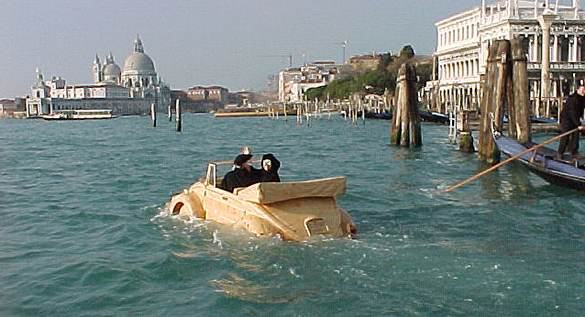
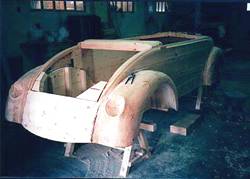
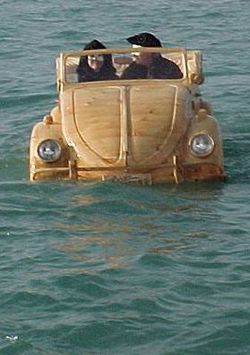
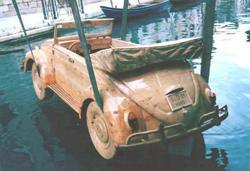
The floating wooden Volkswagen Beetle Convertible 1966is Livio de Marchi's
fourth car. It was preceded by wooden recreations of the Fiat Topolino A
1930s,
the Jaguar SS 1937 and the Mercedes Gullwing SL 300 1955. These
wooden masterpieces serve a specifically Venetian purpose as well, for
although cars have been banned from that city, boats are free to go wherever
the canals take them (and at breakneck speed more often than not, we should
add!). The premeditated irony of Livio de Marchi's wooden cars is provided,
among other things, by the sharp contrast with the speed of their metal
counterparts: the wooden Beetle Cabriolet chugs along the canals endearingly
sluggishly, managing just enough speed to produce a genuine yet gentle backwash.
Technical specifications:
Constructed in pinen (Cirmolo) 1998-1999
Dimensions:length 390 cm, width 155 cm, height 135 cm
Weight: 600 kg
Driving gear: one-cylinder Yanmar ship diesel
Maximum velocity: 5 kilometres/hour, engine capacity 10 hp
Deadweight capacity: four adults
|
|


|